
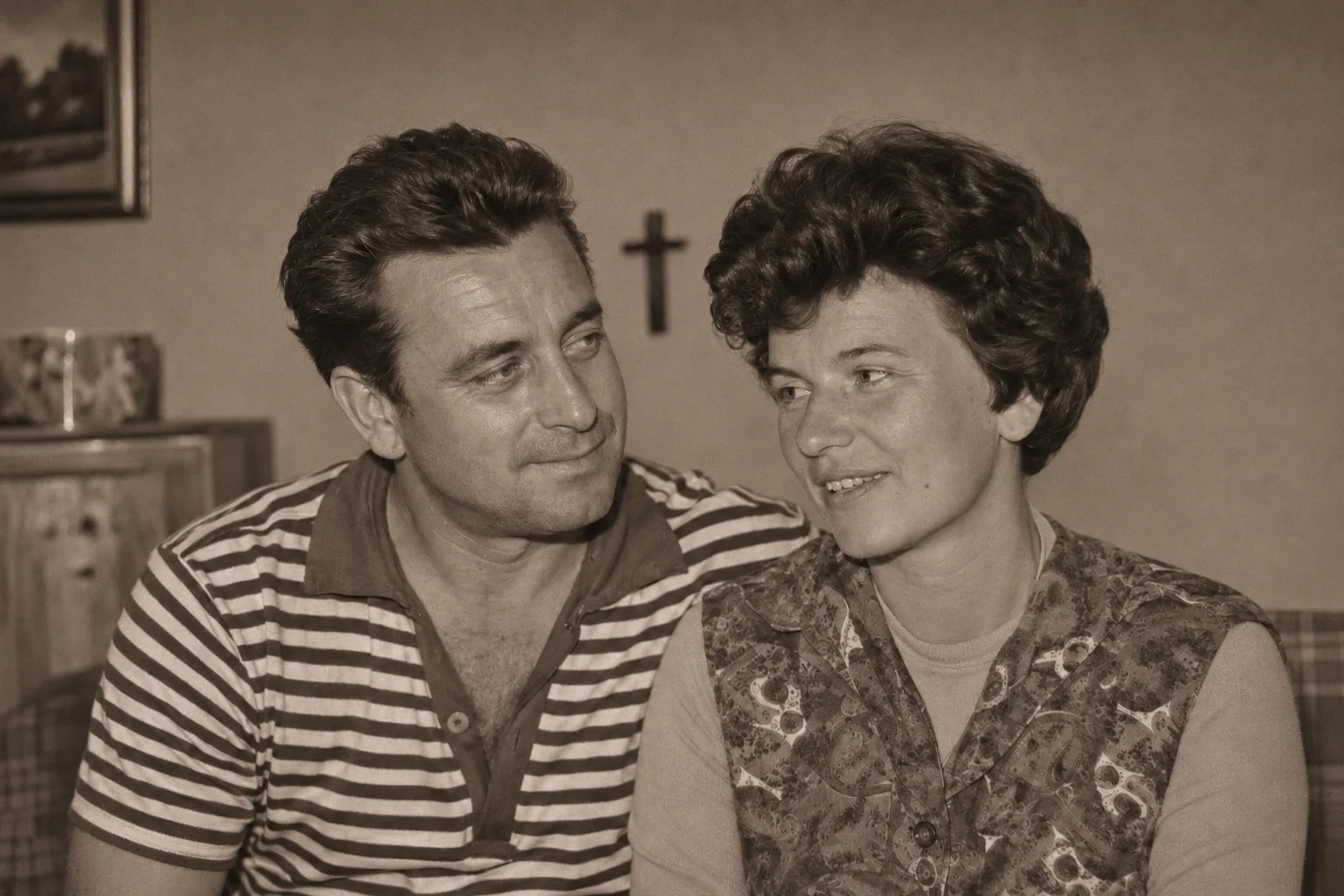
Karel Suszka and Marie Suszková. Family photograph digitally re-composed and sepia toned using AI.
Remembering Grandpa, with Grandma Marie and my aunt Jana.
To me, they were always simply Grandpa and Grandma - Karel and Marie. Grandpa introduced me to photography when I was about eight. Now, as I work through his old photographs and negatives, I want to know more about his life before I knew him as my grandfather.
My aunt Jana has been helping me piece together Grandpa’s story, talking with Grandma and writing down her memories. Thanks to them, I’m getting to know parts of his life that began long before I was born.
And Grandma belongs here beside him. She was his lifelong support, and so much of what we can tell today comes from what she remembers.
Grandpa and the Missing Milk
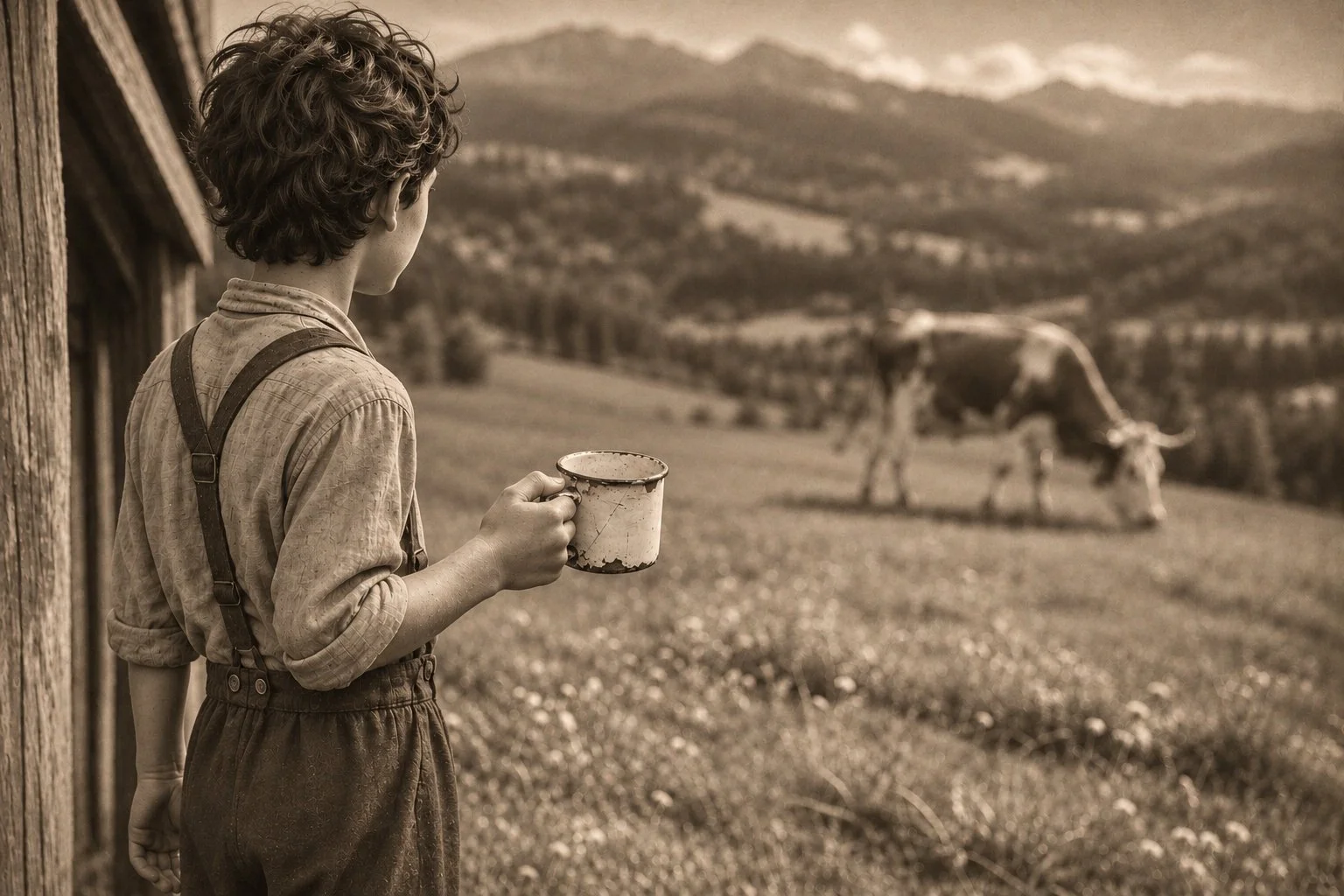
Artistic reconstruction inspired by a family memory; not an archival photograph.
One of the stories Jana has written down is about Grandpa as a boy in Písek, near Jablunkov. He was about nine or ten and used to take the family cow, Stračena, out to graze. He also took a mug.
He had learned to milk her, so when he wanted a drink, he helped himself. Back at home, his mother wondered why Stračena was giving so little milk. She didn’t know that some of it had already gone into her son’s mug.
I like having this little story alongside the dates and places. It gives me a glimpse of Grandpa as a boy, getting up to something his mother knew nothing about. But there was hardship in that childhood too. Grandma tended goats when she was young, and both knew what it meant to grow up with very little.
Jana describes Grandpa as a lively, restless child. He attended a Polish school; during the German occupation, lessons were taught in German. A strict teacher and a boy who found it hard to behave were not an easy combination.
He Wanted to Be a Tailor
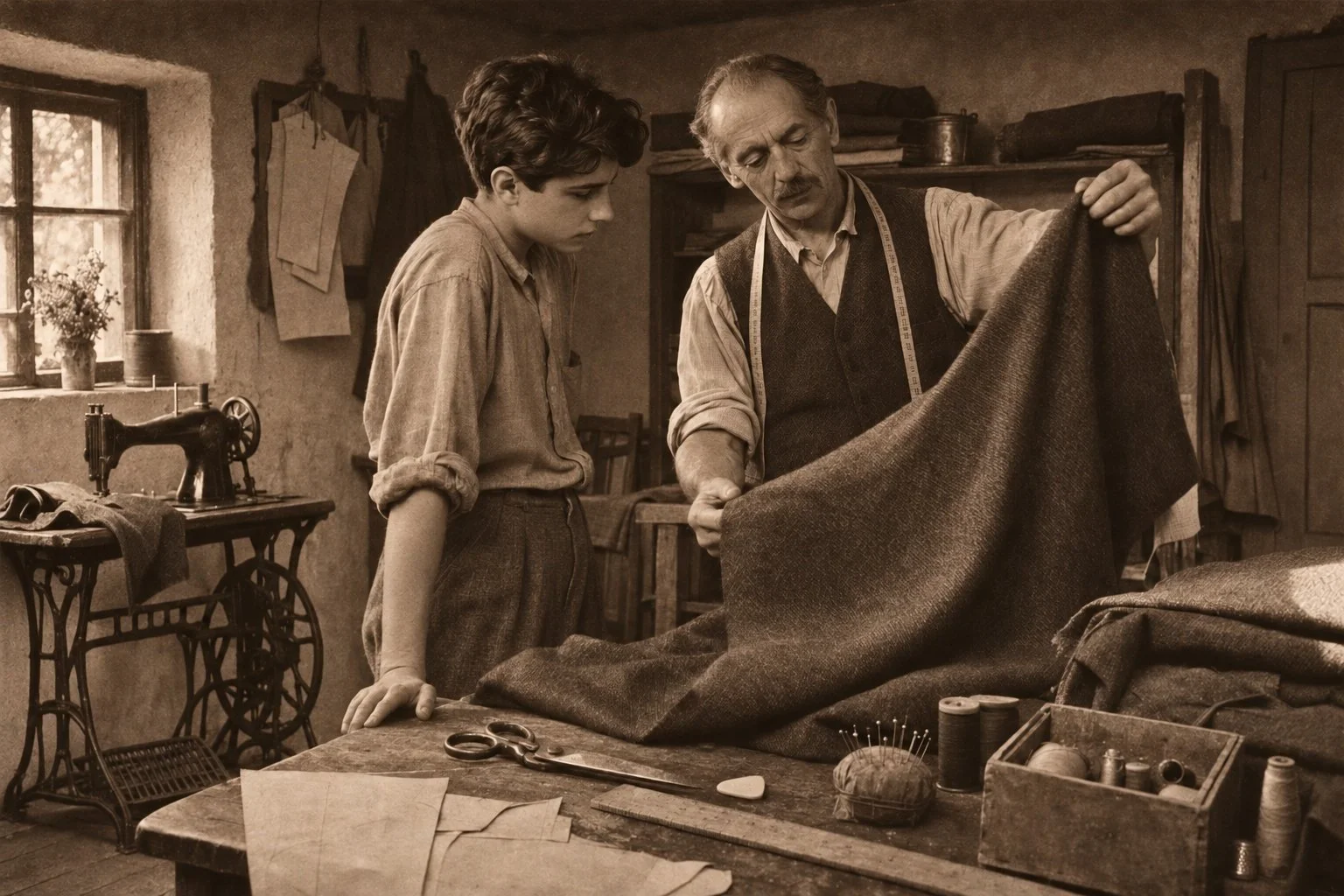
Artistic reconstruction inspired by his work with Jan Sadový, 1943-1945.
Jana once asked Grandpa what he had wanted to do for a living. He told her he had hoped to study clothing and tailoring. That was the path he would have chosen.
In 1943, his father, Pavel, arranged for him to help the tailor Jan Sadový. He stayed until 1945. As the family tells it, he was not allowed a formal apprenticeship because he was Polish. Even so, he learned the work: how to sew, make clothes to measure, and recognise the qualities of different fabrics.
Grandma remembers that he put those skills to use during his military service, from 1946 to 1948, sewing and repairing clothes for soldiers. Later, making a living and providing for his family took him into other work.
But he still had something to teach Jana when she became interested in sewing. She took courses in sewing and pattern cutting, and he helped her learn. In her notes, she writes about how grateful she is for what he taught her.
A Home of Their Own
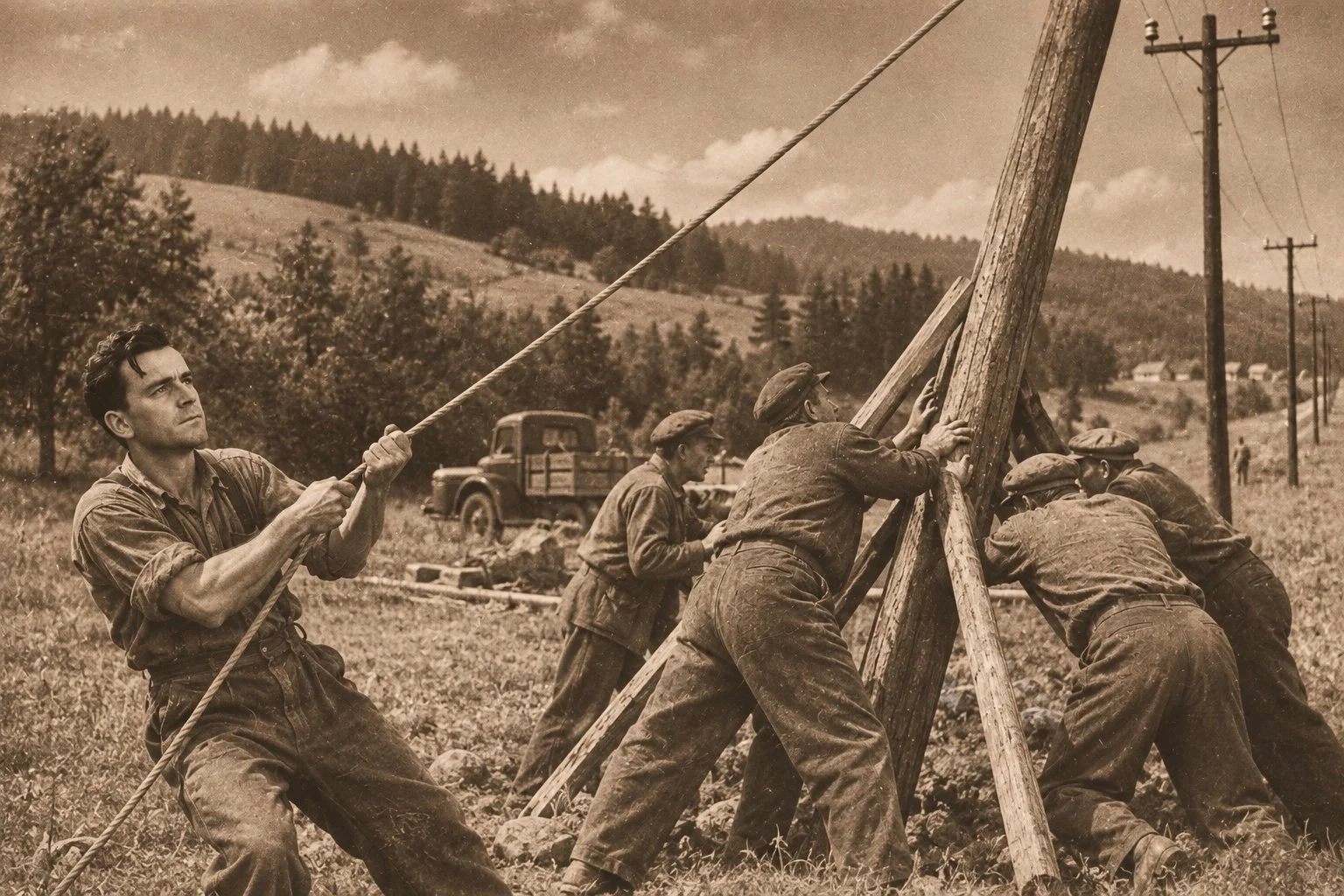
Artistic reconstruction inspired by rural electrification work, 1948-1950.
After the army, Grandpa went to the Bruntál region to help bring electricity to villages. He worked there from 1948 to 1950, learning from the electricians and doing what was needed. The work interested him, but it didn’t pay much.
When mining work offered better wages and the possibility of a home, he went to the Žofie mine in Orlová. He worked there until retirement. Jana is quite clear about why he became a miner: he needed to support his family.
For Grandpa and Grandma, getting their own apartment in Havířov meant a great deal. They had had nowhere of their own to live in Písek. The early days in Havířov were difficult - roads and pavements were unfinished, and supplies were unreliable - but things gradually improved.
Jana remembers how happy they were to have their own place. Both spoke of their years in Havířov as some of the happiest of their lives. Jana remembers them fondly too; she lived there for twenty-six years, until she married.
The Camera He Won
Grandpa’s first camera came from a raffle. He and Grandma went to the Miners’ Day celebrations each year, and at one of them he won a camera. Grandma puts it at 1958 or 1959; she isn’t sure which.
At first, he wasn’t sure what to do with it. Fortunately, a neighbour, Mr Grimm, was interested in photography and helped him get started. Jana remembers going for walks with Mr Grimm and his wife along the Lučina River. Grandpa and Mr Grimm would talk about photography as they walked.
There was plenty else he enjoyed. He played football as a goalkeeper, first in Písek and later in Havířov. He followed hockey, athletics, the World Cups and the Olympics, and liked a good historical novel or detective story.
What He Taught Us
Jana says Grandpa was happy that he could teach me to take photographs. He had wanted to teach her too, but photography never caught her interest the way sewing did. We each found something different to learn from him.
I have been taking photographs since I was about eight. Now I’m also digitizing and restoring his photographs and negatives. Alongside that work, Jana and Grandma are helping me put names, memories and stories around his life.
I want to keep adding to these pages as we find more. And I want Marie here beside Karel, where she belongs. These are Grandpa’s stories, but so many of them are Grandma’s too.
About the Memories and Images
Written by Jiri Kriz from family memories collected by his aunt Jana, including recollections from his grandmother, Marie Suszková. Dates follow the family’s account; the camera raffle is dated to 1958 or 1959.
The cover is a family photograph digitally re-composed and sepia toned using AI. The three chapter images are AI-created artistic reconstructions, not archival photographs.